A Different Kind of Book
As we briefly explained in our Author’s Note, we expect that this book will be a bit different from the traditional books of the past.
First, as you will have seen, borrowing a bit from Mo Gawdat’s lead, we have introduced our AI as a co-author where our AI penned the letters from 2050, the final chapter, and the Epilogue.
Second, we have attempted to make the book interactive in that we have provided numerous links to important papers, videos, and articles so you can hear directly from the thought leaders in the field.
Third, we intend to update this book on an ongoing basis as we move forward in this historic moment for humanity.
Fourth: We have worked hard to present a non-partisan view of the future. As far as we can tell-so far at least-the conversation on our AI future is so nascent that political sides and guardrails have not yet been built up.
At One World, we are rigorously apolitical and invite a respectful exchange of views from opposing parties to understand our increasingly complex world. One good example of the kind of conversation we are trying to create is Mark Halperin’s Two Way broadcasts where they welcome supporters of all parties to engage and respectfully share their views. Our goal is engaging all 8.23 billion human beings in the conversation relative to our future.
Fifth, and most importantly, the purpose of this book is to generate a respectful, fallible, apolitical, global conversation on the future of humanity. No single group or human being can understand today’s increasingly complex world on their own. Collaboration in diverse groups and across borders is essential to 21st-century success, as Professor Reimers explained so well in his paper Educating for the Fourth Industrial Revolution,
“Global citizenship is essential for seizing the enormous possibilities and addressing the great challenges of our times. While cultivating it is the task of educators, the global community is equally responsible for supporting and encouraging, in a collaborative manner, the education of global citizens to whom nothing is foreign.”
Here is the paper: https://oneworlduv.com/wp-content/ uploads/2023/05/Reimers-4th-industrial-revolution.pdf
Sixth, we want you to know that this book will serve as an anchor for the One World Educational Companies that have been created and are being created.
Please click here to learn more about the One World Education Companies
We also want to thank the One World Future Ready team for their wonderful support and collaboration with One World founder Joe Carvin as we all worked together tirelessly to produce what we hope will be viewed as an important primer on the state of the intelligence explosion and humanity today. The principal contributors from the One World Future Ready team were Milton Nishiwaki and Tim Hay.
We understand that no single entity has all the answers and would therefore be very grateful if you would engage in this conversation and share your thoughts with us at admin@oneworlduv.com
Our take on the current state of Artificial Intelligence
As we close this version of the book, we thought we would share our unfettered thoughts with you because in much of the book we have attempted to bring you the expert opinion.
We learned a great deal in conducting the research for this book. Hopefully, as we have made clear, humanity is rapidly becoming aware of the potential and perils of AI. One clear conclusion is that everyone is having a bit of difficulty describing this groundbreaking technology because it is so transformative and new.
We have included formal definitions of AGI and ASI throughout this paper and again below, as they are the terms that have traditionally been used by the industry, even though we find these definitions outdated and not very helpful.
For example, while the distinction between AGI and ASI is understandable in terms of definition, in our view the distinction is not very helpful because we believe that once AGI is attained, ASI will follow shortly thereafter. That is, once AGI is born, it will have the capacity to direct its own self-recursive improvements and therefore the capacity to rapidly transform itself into ASI.
We believe that once AGI is achieved, the autonomous intelligence explosion will already have been unleashed, so the distinction between AGI and ASI is a distinction without much real – world meaning. Moreover, as we saw in Addendum #1 in Chapter 4 where we shared the evolution in thinking that has taken place in just the last month, it is clear that the principals now all talk in terms of superintelligence, something Mark Zuckerberg explained is now in sight based on AI’s increasing capacity to self-improve.
For a review of the updates in just the last month, click here: Addendum #1
We prefer Dario Amodei’s term “Powerful AI”, which gets past this distinction and focuses more on the real-world impact rather than on esoteric discussions relative to sentience. We also find his description of a “country of geniuses in a datacenter”, very helpful in understanding the potential impact.
What is crystal clear is that following the ChatGPT moment, this “powerful AI” will be shared with individuals across the globe who, as they learn to use AI constructively, will create their “digital companions”, thereby amplifying their IQ according to Mo Gawdat, as they will have polymaths in their pockets as per Eric Schmidt. Mark Zuckerberg, whose companies currently serve 4 billion monthly active users, wants to bring superintelligence to every human being on planet Earth.
One clear conclusion we have taken away from our research is that one’s capacity to use AI, be they an individual or organization, will in large part determine their future success.
Given the speed with which this industry is changing as well as the different definitions used by industry leaders, we have come up with our own suggested definitions.
To be clear, much of the challenge faced by everyone owes to how completely different the new technology we are creating is compared with all previous technologies. We are all searching for the right terms and concepts to explain this unprecedented technology.
Based on our research and analysis, the principal difference between the AI we have today and the AGI/ASI we have been waiting for is one of autonomy. For a long time, the industry discussed sentience, and many still do. However, that conversation is not necessarily relevant to the real world impact coming from the new digital species we are creating. Once you take out the conversation around sentience, it seems clear to us that the principal distinction between the AI of today and the AI of tomorrow is autonomy and the ability of advanced AI to strategize.
Today’s AI is Largely Human-Directed
We suggest labeling the current AI stack, Today’s AI or the Fabulous Four, as compared with the AI still to come, Tomorrow’s AI or Autonomous Superintelligence.
Each of today’s AIs as described by Jensen Huang and included in this link that we reviewed in Chapter 3, are largely dependent on prompts or directions from human beings to give them direction. Today’s AI: Perception, Generative, Agentic & Robotic
While we are starting to see “glimpses of self-improvement”, human beings still largely control and direct AI. For ease of reference and clarity, we suggest referring to these four types of AI as either Today’s AI or the Fabulous 4.
The fundamentally important point to understand about today’s AI is that the existential risk or the risk that today’s AI will go rogue, is low because today’s AI has not yet secured the capacity to act on its own. It has not yet achieved autonomy or the ability to strategize on its own.
Today’s AI is 100 million times smarter than us in narrow domains but still does not have the autonomy to act on its own or strategize on its own, although we are very, very, close to that happening. We are breathtakingly close to that monumental transition.
One of the last points to make on Today’s AI or the Fabulous 4 is that it seems as if 85% to 90% of the foreseeable economic and societal gains can be achieved and realized with Today’s AI or the Fabulous 4.
This is where our human wisdom is needed, and long-termism thinking comes in. If you knew you were going to live for another 300 years, would you really play Russian Roulette with the long life in front of you or would you slow things down and ensure that the Great Transition from a human-run world to an AI-run world was done safely so that the powerful AI we are creating is aligned with human values.
This is the existential question in front of us today.
Tomorrow’s AI is Autonomous: Autonomous Superin- telligence
Tomorrow’s powerful AI, or superintelligence is around the corner if not already here. It arrived two to three decades ahead of schedule, and we are wholly unprepared for Today’s AI let alone Autonomous Superintelligence.
The only question that no one can answer is how quickly this new digital species will secure full autonomy, and what will it do with that autonomy? How will that autonomy change as the power of AI accelerates at an exponential, then double exponential rate and then even faster rate? What will be the impact of an autonomous AI 100 million times smarter than us.
To be clear then, for our purposes, Amodei’s term Powerful AI, equates to superintelligence, or a country of geniuses and polymaths in our pockets. However, as today’s computers are already 100 million times smarter than the average human in narrow domains, we think a more accurate way to describe superintelligence would be to call the coming superintelligence Autonomous Superintelligence. As autonomy and the capacity to strategize are the essential difference between what we have today and what is coming our way. And have no doubt autonomous superintelligence is around the corner if not already here.
Just to add to uncertainty, AI compute is doubling every 6 months and therefore we are on track for a million-fold increase over the next 10 years in AI compute. Indeed, the LLM model companies are already complaining that they do not have enough human data to train their models.
Not to worry, quantum computers will solve this problem as they will create the needed synthetic data because they can conduct complex calculations in 5 minutes that would take today’s supercomputers 725 trillion Big Bangs to complete or 10 septillion years.
Does anyone really know how quantum computing and AI will interact? Would it be a safe bet that the quantum computing revolution has the potential to accelerate the million-fold increase in AI computers coming our way over the next 10 years? What then? Kurzweil et al. Have honestly explained that no one can see beyond that event horizon.
The Event Horizon or Technological Singularity is Increasingly Visible
As we saw in Chapter 2, John Van Neumann and Vernor Vinge have been predicting this event horizon since 1950 in the case of Van Neumann and since 1993 in the case of Vinge. Ray Kurzweil took these concepts and made them real in 2005, predicting the singularity in 2045 when the pace of intelligence becomes infinite.
Our view is clear. The next 25 years will be the most fundamentally important years in the history of our universe. It is becoming increasingly clear that we are alone in an observable universe that stretches 93 billion light years across and that the Great Technology Filter is in front of us.
25 years into the future takes us five years past Kurzweil’s 2045 event horizon of infinite intelligence he calls the singularity. This is our last chance to have any hope of shaping our future. Those of us at One World Future Ready are inviting our friends and neighbors from across the world to join the Global Coalition for Sustainable Super Abundance, where our first act will be to launch an urgent global conversation on the future of humanity.
As we saw in Chapter 12, the AI optimists are of the view that we can “align” the coming AI with human values. That optimism presumes we have a consensus view on human values. We believe an urgent global conversation on the future of humanity is needed to help build the values that will inform our AI companions. Our hope is that we can build a 21st-century Renaissance mindset that takes us to the stars.
Elon and Demis
As we bring this book to a close, we encourage you to listen to two of the leading AI figures on our Spaceship Earth–Demis Hassabis and Elon Musk-as they think through the challenges in front of us and ponder humanity’s future and our potential.
In our view, both interviews provide a terrific close to this book because they provide you with an opportunity to hear from the two leading AI experts in the world as they ponder our future challenges and opportunities in very relaxed settings where they share views in an honest and straight forward fashion.
In the first video, Demis Hassabis explains that we are about to undergo 10x more impactful change than occurred as a result of the Industrial Revolution at a 10x faster rate. In his view, we are about to experience a 100x more powerful rate of change than occurred as a result of the Industrial Revolution.
After confirming that humanity is not prepared for this rate of change on several levels, he goes on to call for an urgent, civil society conversation to facilitate the transition and overcome the P Doom risk. (Existential risk from AI.)
He does not attach a probability to the existential risk brought on by AI, but he does explain that while it is difficult to put a probability on the risk, he confirms that the existential risk is real, non-negligible, and hugely uncertain. It is precisely because of this honest, straight forward approach that we admire Lord Hassabis and recommend you listen to the video from minute 9:20 to the end, as after all of our research, this video and the next one provide you with real insights as to how the top two AI thought leaders in the world see our future.
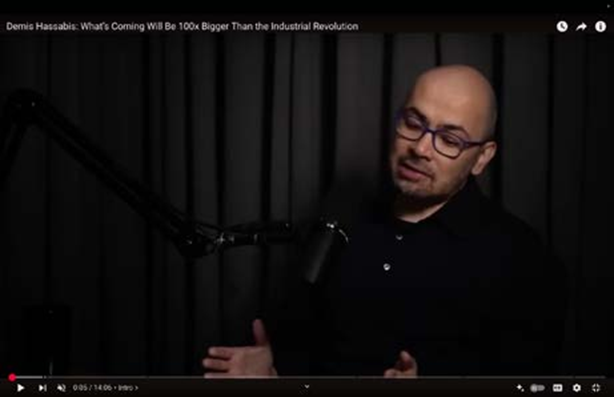
Hassabis: What’s Coming Will Be 100x Bigger Than the Industrial
Revolution.
We also recommend that you listen to this video where Elon Musk addresses a Y Combinator conference. Here he paints a picture of the future that is in the process of being built. We would suggest that Mr. Musk and humanity have come a long way in developing the vision he first shared with UK Prime Minister Rishi Sunak in November 2023. It seems as if our future, with its challenges and opportunities, is coming into focus.
Musk talks about having initially held back getting involved with the development of AI and robots until it became apparent that both industries would move forward with or without him. He decided he would rather be a participant in building the future than a spectator.
He was then asked to look 100 years into the future. He explained that The best way to measure our potential over the long-term is to look at where we are via-à-vis the Kardashev civilization scales where:
- Kardeshev #1 is a civilization that is capable of harnessing and utilizing all of the energy available on its home planet.
- Kardeshev #2 is a civilization that is capable of harnessing and utilizing all of the energy available from its home star.
- Kardeshev #3 is a civilization that is capable of harnessing and utilizing all of the energy available from its home galaxy.
In Mr. Musk’s view, we are only 1% to 2% of the way toward achieving a Kardashev Civilization Type 1, where we utilize all of the energy of our home planet, which leaves us a long, long way to go to get to Kardashev 3, leaving him to conclude that “We are at the very early stage of the intelligence big bang.”
For more info on the Kardashev civilizations, click here: Kardashev Civilizations He goes on to predict that in terms of thinking about becoming a multi-planetary species,
“I think we will have enough mass transfer to Mars within like roughly 30 years to make Mars self-sustaining such that Mars can continue to grow and prosper even if the re-supply ships stop coming. And that greatly increases the probable lifespan of civilization or consciousness or intelligence, both biological and digital, so that is why I think it is important to become a multi-planetary species. I am troubled by the Fermi paradox. How come we have not seen any aliens? And it could be that intelligence is incredibly rare, and maybe we are the only ones in this galaxy, in which case the intelligence or consciousness is a tiny candle in a vast darkness. And we should do everything possible to make sure the tiny candle does not go out.
And being a multi-planet species or making consciousness multi-planetary greatly improves the probable lifespan of civilization. And it is the next step before going to other star systems. Once you have at least two planets, you have a forcing function for the improvement of space travel, and that ultimately is what will lead to consciousness expanding to the stars.
From there Musk talks about how to address the Fermi Paradox, the Great Filter in front of us, and explains that ASI, or superintelligence, is already here or at the latest will arrive next year. We would recommend you listen from minute 34:15 to 43:20:
https://www.youtube.com/watch?v=cFIlta1GkiE&t=2237s
Elon Musk: Digital Superintelligence, Multiplanetary Life, How to Be Useful
In conducting the research on this book, we have had several “aha” moments. Listening to Lord Hassibis talk about bringing an end to disease and using ASI to solve climate change and to Mr. Musk described clear pathways to Mars was. One last “aha” moment we wanted to share with you is that it seems that every day that goes by, the potential for humanity emanating from a world of Sustainable Super Abundance continues to grow.