“Any sufficiently advanced technology is indistinguishable from magic.” — Arthur C Clarke
As trillions of dollars are invested in the Technology Tsunami, one fundamentally important concept to understand is technological convergence, in which previously separate technologies combine to create capabilities far more powerful than any individual technology could achieve alone.
We are going to look at technological convergence as it relates to humanoid robots, as well as to a possible post-human future.
Humanoid Robots: A Fundamental Transformation of Civilization as We Know It
“One thing I learned from working as an emerging markets investor is there is no better window to the world or the future than the stock market, as market participants are always trying to predict the future” –Joe Carvin, the founder of One World Future Ready (and principal author of this book).
Wall Street is working overtime to understand how humanoid robots will impact our future from an economic and societal point of view. To that end, there have been some excellent reports on humanoid robots published by Wall Street firms—two by Morgan Stanley, and one each by Citibank and Bank of America. In addition, Peter Diamandis and his team at Abundance 360 have pulled together a terrific overview of the Humanoid Robot Megatrend. The Congressional US-China Economic Security and Review Committee has also weighed in.
You can access each of these reports by clicking on this link:
Reports on Robots
Two of the leading thinkers on technological innovation, Jensen Huang, the CEO of Nvidia, and Kathy Wood, the founder of Ark Invest, have also been pointing the way forward relative to the development of humanoid robots.
Several themes are picked up by each of the reports, the first and most prominent being technological convergence. Here is an extensive quote from the Abundance 360 report:
“Why are we seeing such an explosion of activity in the humanoid robot field now? Beyond any single technical advancement, the convergence of five major technological areas (is) super-charging this field: multimodal generative AI, high-torque actuators, increased compute power, enhanced battery life, cameras, and tactile sensors.
“This, in combination with voice recognition, is transformative: As Brett Adcock recently told me, ‘We can literally talk to our robot, and it can implement the tasks you request—the end-state for this is you want the default UI (user interface) to be speech.’”
The report goes on to conclude that “The rapid advancement of humanoid robots isn’t the result of a single technological leap, but rather a remarkable convergence of multiple innovations across various fields.” The Abundance 360 report explains that AI advances are at the heart of this revolution given the “extraordinary progress in multimodal, generative artificial intelligence—for example, Open AI GPT-4o’s ability to see, listen, and speak” and that these advances in software have been further enhanced “via advances in hardware in the form of improved sensors, actuators and other physical components as well as the dramatic improvements in battery storage.”
The Wall Street reports reach similar conclusions, with the Citibank report stating, “Multiple technological advances, especially in Artificial Intelligence (AI), have dramatically changed the outlook for robots.”
The Citibank report highlights nine changes in its first chapter of the report, with the most significant being “advancements in AI allowing robots to see, to learn, to move, to talk, to take instructions into code and then actions. Only recently has multi-modal AI allowed all these elements to fit together. AI, in turn, is becoming embodied and physical. In parallel have been advancements in dexterity. Some robots can now thread a needle or suture a kernel of corn. Robots are on the move, from theory to reality and from useless to useful.”
Morgan Stanley reached the same conclusion in its report:
“GenAI is transforming how robots ‘learn’ by giving them a chance to observe and imitate behaviors in both the physical and virtual world, connected through natural language and iterated in the datacenter. Similar to how large language models (LLM) help drive ever greater capability of ChatGPT, multi-modal models (MMM) are driving innovation in robotics. AI algorithms can significantly shorten the R&D cycle by automating repetitive tasks, enhancing data analysis and predictive capabilities, enabling virtual simulation, and optimizing design and testing processes. As an ‘AI-adjacent’ field, humanoid hardware development can now directly benefit from the increased capital formation and R&D investment into the robotics theme.”
We have included each of the above conclusions as they form the basis for making clear that the world of abundance, which we are discussing, is increasingly feasible and visible. In the Abundance 360 report on robots, Peter Diamandis quotes Brett Adcock, the founder of robotics company Figure, who said, “You can basically create a world where goods and services prices are trending to zero in the limit and GDP spikes to infinity… You basically can request anything you would want, and it would be relatively affordable to everybody in the world.”
The report also quotes Elon Musk, who explains, “This means a future of abundance, a future where there is no poverty, where people can have whatever you want, in terms of products and services. It really is a fundamental transformation of civilization as we know it.”
Based on the projections from each of these reports for the number of humanoid robots that are about to be delivered into our world, it seems clear that civilization as we know it will be transformed. (In this report, McKinsey and Company tallies the global workforce at 3.6 billion workers.)
Compare the McKinsey workforce estimate with the number of humanoid robots Citibank projects between 2035 and 2050: “We are entering a new era in which AI-robots and humanoids will be moving all around us. Our analysis suggests there will likely be 1.3bn AI-robots by 2035 and 4bn by 2050.”
Bank of America projects three billion robots by the year 2060. According to Abundance 360, Brett Adcock and Elon Musk “predict as many as 1 billion to 10 billion robots by 2040.”
One of the big reasons experts are predicting dramatic growth in the build-out and deployment of humanoid robots is that the cost of production is rapidly falling, accelerating the projected payback periods for investors. Costs are expected to come down from the $250,000 range to a point where humanoid robots can be produced for $20,000 or so.
To get a sense of how fast things are moving, look at the first paragraphs of the two recent Morgan Stanley reports on humanoid robots. The first report was released on June 26,2024, covering 66 companies ready to participate in a total addressable market of $30 trillion. It published a second report seven months later, where the number of companies increased to 100 and the total addressable market was $60 trillion.
Here is the opening to that Morgan Stanley June 2024 report:
“Humanoids: Investment Implications of Embodied AI Generative AI is driving transformational change in robotics, rapidly accelerating capital formation and adoption rate. Labor tightness and demographics further underpin the business case. TAM $30 trillion global labor market. Our “Humanoid 66” stock list offers exposure to the theme.”
Here is the opening to its report of February 6, 2025:
The Humanoid 100: Mapping the Humanoid Robot Value Chain
The physical embodiment of AI touches a $60tn TAM, global GDP, and the meaning of work. Morgan Stanley presents the “Humanoid 100” — a global mapping of equities across a range of sectors and regions that may have an important role in bringing robots from the lab to your living room.
As GenAI continues to migrate from the digital world (bits/bytes) to the physical world (atoms/photons) investors are beginning to grasp the enormity of the potential disruption while struggling with ‘paths to expression’ on the theme.
“In our original Humanoid BluePaper, we introduced the Humanoid 66 — a list of both enablers and beneficiaries that we believed were most exposed at the time. Since then, commercial developments have evolved at a rapid pace, especially in China, with many new players announcing their involvement or intentions to become involved. Investor interest seemed to accelerate meaningfully following NVIDIA CEO Jensen Huang’s 2025 CES presentation, where he devoted roughly 40 minutes to the topic of physical AI and robotics.”
One of the reasons Morgan Stanley expanded its company coverage was to accommodate China’s push to build a national capacity to produce humanoid robots, leading the US-China Economic and Security Review Commission (USCCC.gov) to publish this alert on humanoid robots.
Our goal here is not to provide a comprehensive analysis of the humanoid robot market, as each of the reports provides an in-depth analysis of this rapidly emerging sector. Our goal here is to provide a clear sense of the changes to come. What seems crystal clear to us is that there is an extremely high probability that humanoid robots guided by Deep AI will be in a position to do much, if not all, of the work currently conducted by human beings, making clear that the world of abundance predicted in Chapter Five is technologically feasible.
The fundamental question for those of us alive today is how we will transition from today’s world, where 3.6 billion of us are employed, to a world where no human being needs to be employed while still receiving a “high universal income.” Will we suffer through a long period of unemployment to get there? And if so, how will we facilitate that transition both within countries and across countries? Answering these kinds of questions will be a focus of the conversation we are hoping to create on the future of humanity.
The 2030s Mega Merger: Organic Human Beings and Machine Intelligence
The other profound transformative change expected to take place on Planet Earth in the next ten to fifteen years, owing to converging technologies, is the potential merger of human beings with machine intelligence.
Three of the world’s leading thought leaders on our future— Ray Kurzweil, Max Tegmark, and Yuval Noah Harari— are all expecting/ predicting that the next step in human evolution will be for human beings to merge with the intelligence we are creating.
Ray Kurzweil’s 6 Epochs
Ray Kurzweil has been at the forefront of this thinking, first with his 2005 book The Singularity is Near: When Humans Transcend Biology, and more recently with his follow-up book in 2024, The Singularity is Nearer, When We Merge with AI.
In the Singularity is Near, Kurzweil explains that “Evolution works through indirection: each stage or epoch uses information processing methods of the previous epoch to create the next. I conceptualize the history of evolution – both biological and technical – as occurring in six epochs.” Page 14, The Singularity is Near Before reviewing Kurzweil’s six epochs, I think it might be helpful to clarify what Kurzweil means by “indirection”. His basic theme is that evolutionary progress is indirect: Each epoch (stage of evolution) doesn’t directly engineer the next; rather, it uses the tools, structures, and systems created in the previous epoch to bring about the next transformation. Therefore, evolution progresses step by step, with each stage using the structures and information-processing methods of the previous one as a foundation to create the next.”
In Kurzweil’s context, “indirection” means that each evolutionary stage doesn’t directly create the next one, but rather builds the tools and capabilities that enable the next stage to emerge. The key insight is that evolution doesn’t jump directly from simple to complex. Instead, DNA enables brains, brains enable technology, technology enables AI, and so on. Each stage creates the information processing tools that the next stage will use to surpass it.
Epoch 1: Physics and Chemistry
The first epoch describes the universe’s origin, where information is embedded in physical and chemical structures. Starting with the Big Bang, matter and energy form atoms and molecules, laying the foundation for complexity without biological or computational systems.
Epoch 2: Biology and DNA
“In the second epoch, starting several billion years ago carbon- based compounds became more and more intricate until complex aggregations of molecules formed self-replicating mechanisms, and life originated.” Page 16, The Singularity is Near
Epoch 3: Brains
“Each epoch contains the evolution of information through a paradigm shift to a further level of ‘indirection.” (That is, evolution uses the results of one level to create the next.) For example, in the third epoch, DNA- guided evolution produced organisms that could detect information with their own sensory organs and process and store that information in their own brains and nervous systems.” Page 16, The Singularity is Near
Epoch 4: Technology
“Combining the endowment of rational and abstract thought with our opposable thumb, our species ushered in the fourth epoch and the next level of indirection: the evolution of human-created technology.” Page 16, The Singularity is Near
Epoch 5: The Merger of Human Technology with Human Intelligence
“In theFifth Epoch, we will directly merge biological human cognition with the speed and power of our digital technology. This is a brain computer interface …augmenting our brains with nonbiological computers will allow us to add many more layers to our neocortices — unlocking vastly more complex and abstract cognition than we can currently imagine.” Page 8, The Singularity is Nearer
Epoch 6: The Universe Wakes Up
“The sixth epoch is where our intelligence spreads throughout the universe, turning ordinary matter into computronium, which is a the ultimate density of computation.” Page 8, The Singularity is Nearer
Kurzweil explains that we are now in the Fourth Epoch, with our technology already producing results that exceed what we can understand, and then goes on to explain that in the 2030s, we will begin a process where human brains merge with the new digital species we are creating which as the process evolves will lead to a million-fold increase in our intelligence by 2045 leading to what he describes as the Singularity.
“A key capability in the 2030s will be to connect the upper ranges of our neocortices to the cloud, which will directly extend our thinking. In this way, rather than AI being a competitor, it will become an extension of ourselves. By the time this happens, the nonbiological portion of our minds will provide thousands of times more cognitive capacity than the biological parts.”
Max Tegmark’s: Life 3.0 Being Human in the Age of Artifi- cial Intelligence
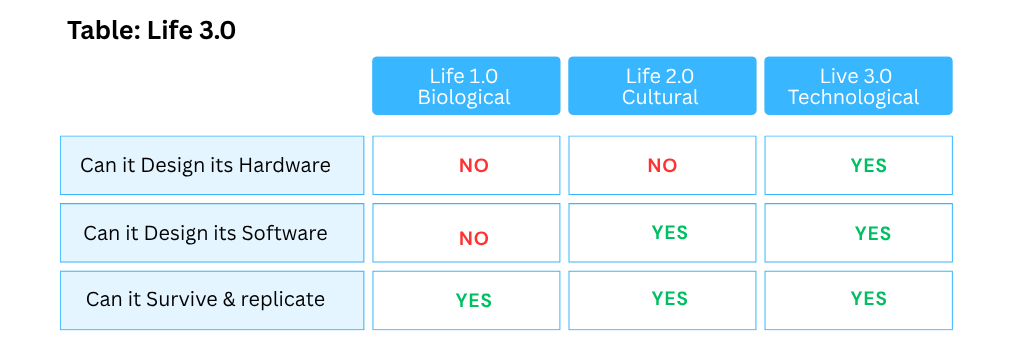
In Life 3.0: Being Human in the Age of Artificial Intelligence, Max Tegmark puts forward a similar concept where he describes three categories for the evolution of humanity. He introduces the concepts of Life 1.0, Life 2.0, and Life 3.0 to describe stages of life’s evolution based on how it designs its hardware (physical form) and software (intelligence or behavior).
These categories reflect increasing autonomy and complexity in information processing, with each stage marking a leap in life’s ability to adapt and shape its future.
Life 1.0: Biological Evolution. This refers to life forms whose hardware and software are both designed by biological evolution, with little to no ability to modify either.
Life 2.0: Cultural Evolution. This describes life forms, primarily humans, that can design their software through learning and culture while remaining constrained by biologically evolved hardware. Humans learn complex behaviors—language, skills, and societal norms—during their lifetimes, effectively reprogramming their “software” without altering their genetic makeup or physical bodies (hardware).
This ability to adapt through education, innovation, and cultural transmission allows Life 2.0 to create tools, art, and civilizations, far surpassing the capabilities of Life 1.0. Tegmark writes, “Life 2.0 can change its software, learning complex new skills, but its hardware is still fixed by evolution.” This stage, emerging with Homo sapiens about 300,000 years ago, marks a significant leap in flexibility but is limited by biological constraints like brain size and lifespan.
Life 3.0: Technological Evolution. This represents life forms capable of designing both their hardware and software, achieving unprecedented autonomy through advanced technology, particularly artificial general intelligence (AGI).
Unlike Life 2.0, which is bound by biological bodies, Life 3.0 could redesign its physical form (e.g., through robotics or nanotechnology) and intelligence (e.g., via AI algorithms), potentially existing as purely digital entities or hybrid systems.
Tegmark states, “Life 3.0 can design not only its software but also its hardware, freeing it from the constraints of biology” (Life 3.0, p. 28). This stage could lead to superintelligent entities, transforming society and the universe.
Yuval Noah Harari’s: Homo Deus
Another global thought leader who predicts the merger of humans with machines is Yuval Noah Harari, who in his 2016 book Homo Deus: A Brief History of Tomorrow, envisions a future where technological advancements, particularly in biotechnology, artificial intelligence (AI), and brain-computer interfaces (BCIs), blur the line between organic and inorganic systems. Harari argues that this merger could transform humanity into a new species— “Homo Deus”—with God-like capabilities that as they grow, will, according to Harari, turn death into a technical question. Finally, as humans evolve into new beings, Harari explains that at some point in the not-too-distant future, the beings alive then will be more different from us than we are from chimpanzees.
In an article entitled, Godlike Homo Deus Could Replace Humans as Tech Evolves, published May 31, 2017, Dan Falk does a good job of summarizing many of the conclusions reached by Harari:
“It is very likely, within a century or two, Homo sapiens, as we have known it for thousands of years, will disappear,” Harari told an audience at the Carnegie Council for Ethics in International Affairs recently. “Not because, like in some Hollywood science fiction movie, the robots will come and kill us, but rather because we will use technology to upgrade ourselves—or at least some of us— into something different; something which is far more different from us than we are different from Neanderthals.
“Harari said we’re already moving in that direction: We depend on our smartphones for a staggering number of decisions every day — and that dependence is growing.
“In 2050, it is likely that your smartphone will not be separate from you at all,” Harari said by e-mail from his home in Israel. “It will be embedded in your body via biometric sensors, and it will monitor your heart rate, your blood pressure, and your brain activity 24 hours a day.” Your smartphone will constantly analyze that data, and “will, therefore, know your desires, likes, and dislikes even better than you.” We see versions of this today, with our Amazon accounts, which seem to know our taste in books and music better than we do.”
In the future that Harari envisions, we’ll gradually merge with machines thanks to biometric sensors and brain-computer interfaces. This may sound like science fiction, but it’s already a reality. At Miguel Nicolelis’s lab at Duke University’s Center for Neuroengineering, patients with spinal cord injuries can use a brain-machine interface to control a motorized “exoskeleton” to regain some sensation and muscle control in damaged limbs.” Dan Falk, Godlike Homo Deus Could Replace Humans as Tech Evolves, May 31, 2017.
While we understand that the concept of human beings merging with machines, or living forever, does indeed sound like science fiction, it is interesting that three renowned futurist scholars all posit an eventual merger of humans and machines. Their thought leadership has paved the way, and now the global free enterprise system is moving into high gear to turn these ideas into reality.
While the economic opportunity is nowhere near as transformative as the economic impact coming from robots, analysts are expecting a several-hundred-billion-dollar industry in the US alone.
In a 2024 report entitled Brain Computer Interface Primer: The Next Big MedTech Opportunity? Morgan Stanley analysts wrote:
“This technology has the potential to meaningfully improve the lives of
millions across the globe, suffering from a broad range of conditions. TAM?
$400bn in the US alone, with room for expansion.
“The hype continues to grow, so is now the time for the BCI? What not too long ago felt like science fiction might now become a reality. We’re now entering a period where brain interfaces would be used to treat a range of human health disorders, from motor neuron disease to depression. These devices, termed brain computer interfaces (BCIs) have seen a sharp uptick in interest over recent years, thanks to the likes of Neuralink (founded by Elon Musk) advancing from concept to in-human trials. There’s now a broad range of companies developing unique BCI technologies, varying in mechanism of action and invasiveness, as we begin thinking about how these products transition into the market. We expect commercialization (product launch + reimbursement) of BCIs for medical purposes in about 5 years.”
There are three leading companies operating in the space: Neuralink, Blackrock Neurotech, and Synchron. Neuralink, founded in 2016 by Elon Musk, is the leader. BCI Companies
Elon Musk has articulated Neuralink’s ultimate ambition as creating a “whole brain interface” (WBI), a brain-computer interface (BCI) capable of connecting the entire human brain to digital systems for seamless, high-bandwidth communication.
This vision, which goes beyond current BCI capabilities, aims to achieve a symbiosis between human cognition and artificial intelligence (AI), enhancing human intelligence, mitigating AI’s existential risks, and potentially enabling transformative applications like cognitive augmentation or consciousness digitization.
In minute 1:04 of this video, Musk confirms that “the overarching goal of Neuralink ultimately is to create a whole brain interface.” Later, he tells us why he is committed to making this happen. “Even in a benign AI scenario, we will be left behind. With a high bandwidth brain machine interface, I think we can actually go along for the ride, and we can effectively have the option of merging with AI.”
Neuralink then provided their Summer 2025 update on June 26, 2025.
You can watch the 59 minute video via this link
Or read our brief overview summary here: Neuralink Summer 2025
We think it is extremely interesting that two of the leading AI futurists in the world, Ray Kurzweil and Elon Musk, believe that one of the best ways to manage AI is to merge with it.
In addition to through leaders and entrepreneurs, the military has been investing in emerging neurotechnology, as Patrick Manning explained in this April 29, 2024, post on LinkedIn:
“In the relentless quest to maintain superiority on the global stage, the U.S. Defense Advanced Research Projects Agency (DARPA) has once again positioned itself at the forefront of technological innovation in defense and warfare. DARPA’s latest venture, the BRAIN (Brain Research through Advancing Innovative Neurotechnologies) Initiative, symbolizes a significant leap towards understanding and harnessing the most formidable organ in the human body—the brain. This initiative isn’t just about enhancing the cognitive capabilities of military personnel; it’s about transforming the very essence of modern warfare and defense strategies.” From Neurons to National Security: Exploring DARPA’s BRAIN Initiative
In fact, according to this article, DARPA, the entity that contributed so much to the development of the internet, has been the primary driver of BCI research in the U.S since at least the 1970s.
How DARPA drives Brain Machine Interface Research.
Our Take on Robots and Brain Computer Interface
Our global geo-political system has many strengths and weaknesses. The strength of the global free enterprise system that has grown up after the fall of the Berlin Wall is the fact that capital will travel seamlessly across the globe to fund new industries that are perceived to have clear economic potential. Indeed, this is one of the reasons the stock market is such a terrific window to the world and the future as people are paid a lot of money to evaluate the companies building and generating those economic opportunities and the entrepreneurs building those opportunities have to tell investors exactly what they are doing every three months.
As we have seen in this chapter, huge amounts of money are being invested in the humanoid robot industry. Why? Because as Jensen Huang made clear the next big breakthrough is expected to be in Robotic AI. The convergence of robotic AI with other improving technologies as we have seen makes clear that billions of robots are likely to be built up over the next 10 to 15 years.
Similarly, converging technologies seem to be making a Brain Computer Interface (BCI) more and more likely.
We believe there is a very real possibility that by 2040, numerous human beings will have merged in some way with the digital species we are creating and the world will have well over one billion robots sharing our planet with us.