Superintelligence Has Arrived or is Imminent
The big debate among technologists for decades has been about when humanity will achieve the more powerful forms of machine intelligence, such as Artificial General Intelligence (AGI) and Artificial Superintelligence (ASI), where AGI can perform any intellectual task that a human can do, across a wide range of domains, with the same level of competence or better.
Artificial Superintelligence (ASI) refers to a hypothetical level of artificial intelligence that surpasses human intelligence across all domains, including general reasoning, problem-solving, creativity, and emotional understanding.
Unlike Artificial General Intelligence (AGI), which matches human cognitive abilities, ASI would exceed them, enabling it to autonomously learn, innovate, and make decisions with unprecedented efficiency and insight, potentially solving complex global challenges like disease or climate change.
ASI is characterized by its ability to perform any intellectual task better than the most capable humans, with self-improving capabilities that could lead to rapid advancements. While still theoretical, ASI raises significant ethical and safety concerns, as its potential autonomy and superior decision-making could reshape societal structures, economies, and governance, as discussed in ongoing AI research and debates on platforms like X.
Source: xAI
As we will attempt to make clear in this chapter, the answer to this question is of fundamental importance to the future of humanity in that we are creating a machine intelligence that surpasses human intelligence in every way. As we will see in the next chapter, if properly guided and “aligned,” AI can help us create a world of Sustainable Super Abundance. On the other hand, on the negative side, the impact could potentially be far more devastating than climate change, and is far more imminent, as we will discuss in Chapter Seven.
However, unlike climate change, this is not an issue that is understood across the world, with organizations like the UN organizing annual
Conference of the Parties to mitigate the risks and ensure the safe deployment of these all-powerful AI systems. Just the opposite. In his ground- breaking paper, Situational Awareness, former OpenAI employee Leo Aschenbrenner estimates that only “a few hundred people, mostly in San Francisco AI labs,” possess, in his words, “situational awareness” of the rapid trajectory of AGI and ASI.
Our goal in this chapter (and this book) is to help readers build their situational awareness relative to AGI/ASI. To that end, we will attempt to review where we are today in terms of understanding AGI and ASI, and review some of the important thinking coming out of San Francisco’s elite. While the conversation has expanded beyond San Francisco since the publication of his paper on June 4th, 2024 the nature and impact of AI and more importantly AGI and ASI is not well understood in part because there is no real consistent definition of AGI or ASI.
The ChatGPT Moment Dramatically Accelerated the Timeline for AGI/ASI
The “ChatGPT moment” in late 2022 significantly accelerated people’s expectations for the arrival of AGI and ASI. The unexpected success of ChatGPT demonstrated the power of large language models, shifting perceptions from AI as a distant goal to a near-term reality.
In his book Life 3.0, Max Tegmark explained that the median forecast for the arrival of AGI at the AI conference that took place in Puerto Rico in January 2015 was 2055.
The ChatGPT moment—its viral adoption and capabilities in generating human-like text—marked a turning point, as it showcased AI’s practical potential, prompting experts and the public to revise AGI/ASI timelines from decades to years. Before ChatGPT, many AI researchers estimated AGI would arrive between 2040 and 2060. For example, the community-driven forecasting platform, Metaculus saw its median prediction go from 2043 to 2029 for the arrival of AGI.
Examples of Timeline Shifts:
Elon Musk: Pre-ChatGPT, Musk estimated AGI by ~2040 (2018, on X); post-ChatGPT, he predicted AGI by 2025–2026 (2023, on X), aligning with xAI’s accelerated goals.
Geoffrey Hinton: In 2020, Hinton projected AGI in 20–30 years; after ChatGPT’s release, he warned in 2023 interviews of AGI within 5–10 years, citing unexpected model capabilities.
OpenAI: Sam Altman’s pre-2022 estimates leaned toward the 2040s for AGI; in The Intelligence Age (2024), he forecast ASI by ~2027, reflecting ChatGPT’s impact on compute scaling.
Source: For specific examples: Elon Musk’s shift from ~2040 (2018 X post) to 2025–2026 (2023 X post) is sourced from X posts; Geoffrey Hinton’s change from 20–30 years (2020 interview) to 5–10 years (2023 MIT Technology Review) reflects post-ChatGPT urgency; Sam Altman’s move to ~2027 ASI (The Intelligence Age, 2024) is from his blog; and X sentiment shared.
AGI vs. Existing AI: What’s the Difference?
When we first started thinking about the difference between AGI and types of intelligence described in the previous chapter and included here below, we asked ourselves how much more different AGI could be from these accelerating levels of intelligence. Moreover, some analysts believe that 85% to 90% of the economic benefit that will accrue from AI is already in place when compared with AGI. Indeed, for someone who is not from the field it seemed the difference could be more definitional than real.
As we saw above, Artificial General Intelligence (AGI) is defined as a hypothetical form of artificial intelligence that can understand, learn, and apply knowledge to perform any intellectual task that a human being can, matching or surpassing human cognitive abilities across virtually all domains.
But let’s be honest: who is kidding whom? Pick your favorite Gen AI: Grok, Claude, Perplexity AI, DeepSeek, or ChatGPT. They are all far smarter than the smartest human being. So clearly, the difference between existing AI and AGI is not cognitive.
In fact, we have attempted to measure the difference in the so-called “intelligence” of your average generative AI as compared with us poor humans. In the previous chapter we shared a Ted Talk from Mustafa Suleyman where he compared the capacity of today’s AI to read and absorb information with the organic humans.
“If someone did nothing but read 24 hours a day for their entire life, they’d consume about eight billion words. But today, the most advanced AIs consume more than eight trillion words in a single month of training.”
If we assume the average book is 80,000 words long that would mean that the average AI would read 1.2 billion books a year. In the US the average reader reads less than 10,000 words per day with the most voracious readers taking in as much as 100,000 words per day. Again assuming the average book is 80,000 words long, the smartest among us would be reading 456 books per year where the average reader would be reading around 12 books per year as compared with the 1.2 billion books consumed by our various AI.
Looked at over a 70 year lifetime the average human consumes about 12 books per year or 84 books over a 70 year lifespan, assuming they read books from day one. The average AI consumes 1.2 billion books so over 70 years the average AI will have consumed 84 billion books meaning that the average AI is 100 million times “smarter” than us or 100 million times better able to read and absorb material than the average human being.
We think this is a good way to describe how much “smarter” the average AI is than the average human. They are 100 million times “smarter” than us.
Even more incredulous, is the fact that so much data is needed to train the large language models that it seems that whole of human knowledge available to all of us on our fingertips is insufficient to train the models adequately.
Indeed, a 2024 report by Epoch AI projected that LLMs could run out of useful human-generated training data.
Position: Will we run out of data? Limits of LLM scaling based on human- generated data
Pablo Villalobos 1 Anson Ho 1 Jaime Sevilla 1 2 Tamay Besiroglu 1 3 Lennart
Heim 1 4 Marius Hobbhahn 1
https://openreview.net/pdf?id=ViZcgDQjyG
It seems the companies are increasingly looking to create their own synthetic data. This is an area where quantum computing could add value.
So the big question becomes why aren’t we already at AGI? As we studied this matter further, we learned that there are three important ways AGI differs from existing AI.
Generalization: The ability to learn, reason, and adapt to new tasks without being specifically programmed for them.
Autonomy: The capacity to make decisions and solve problems
independently in diverse contexts.
Human-like intelligence: Matching or surpassing human cognitive
abilities in areas like reasoning, creativity, and understanding.
AGI, unlike an existing AI, represents true general- purpose intelligence
Over the almost seventy years since the first AI conference at Dartmouth, much time and energy have been invested in trying to determine whether AI would become sentient. Since no human being really knows what it means to be conscious, we will leave that discussion aside, at least in this book, as our goal is to understand the real-world impact of the digital species we are creating.
When artificial intelligence becomes autonomous and achieves agency as never before, that will be a big deal, even if the economic impact is not pronounced. The reason this is such an important advance is that, to some degree, humans will lose control over the “species” we have created.
As we indicated above, we have attached an Annex to the end of this chapter that includes more formal definitions of AGI and ASI, as well as a reference paper produced by a team at Google to begin to provide consistent definitions across the industry.
However, what is clear is that as of today, industry participants use different definitions that lead to differing timelines, which can be a bit confusing. To get a sense of this discussion, we have put forward differing comments from two of the leading AI actors in the world today: Sir Demis Hassabis, the founder of Google DeepMind, and Dario Amodei, the founder of Anthropic, home of Claude. You can watch the full video here.
At minute 1:02, Lord Hassabis explains, “My timeline is a bit longer. My definition of AGI is when AI can exhibit all the cognitive capabilities a human can, and that’s important because the human mind is the only example in the universe that we know of that is a general intelligence. Of course, how to test that is the big question. The one I am really looking for, and that may be why I think it is a little bit further out or a 50% chance in five years, maybe toward the end of the decade. I think we don’t have systems yet that could have invented general relativity the way Einstein did with the information he had available at the time, or another example I give is can you invent a game like Go, not just play a great move like Move 37 or build Alpha Go that can beat the world champion could you actually invent a game like that is as beautiful aesthetically as Go is, so I think it is going to take a little bit longer to get that kind of capability.”
At minute 0:25, Dario Amodei explains that AGI will be achieved
“When we are at the point where we have a model, where we have an AI model that can do everything a human can do at the level of a Nobel Laureate …across many fields, can do anything a human can do remotely tasks that take minutes, hours, days, or months, my guess is we will get that in 2026 or 2027.”
Amodei has expounded on his definition of AGI in a paper he wrote called Machines of Loving Grace, where he looks to explain how the AI he envisions will transform the following five areas of interest:
- Biology and health
- Neuroscience and the mind
- Economic development and poverty
- Peace and governance Work and meaning
Before sharing his view on the potential impact, he makes clear his basic assumptions relative to defining the type of AI he sees coming our way. He makes clear at the outset that he does not like the term AGI and instead discusses and defines a new term he calls Powerful AI.
In our view, his discussion of Powerful AI provides much better insight into the AI of the future than the formal definitions that have been developed but are often ignored. We have therefore included his full discussion on Powerful AI below:
“To make this whole essay more precise and grounded, it’s helpful to specify clearly what we mean by powerful AI (i.e., the threshold at which the 5–10- year clock starts counting), as well as laying out a framework for thinking about the effects of such AI once it’s present.
“What powerful AI (I dislike the term AGI) will look like, and when (or if) it will arrive, is a huge topic in itself. It’s one I’ve discussed publicly and could write a completely separate essay on (I probably will at some point). Obviously, many people are skeptical that powerful AI will be built soon, and some are skeptical that it will ever be built at all. I think it could come as early as 2026, though there are also ways it could take much longer. But for the purposes of this essay, I’d like to put these issues aside, assume it will come reasonably soon, and focus on what happens in the 5-10 years after that. I also want to assume a definition of what such a system will look like, what its capabilities are, and how it interacts, even though there is room for disagreement on this.
“By powerful AI, I have in mind an AI model—likely similar to today’s LLMs in form, though it might be based on a different architecture, might involve several interacting models, and might be trained differently—with the following properties:
“In terms of pure intelligence, it is smarter than a Nobel Prize winner across most relevant fields – biology, programming, math, engineering, writing, etc. This means it can prove unsolved mathematical theorems, write extremely good novels, write difficult codebases from scratch, etc.
“In addition to just being a “smart thing you talk to,” it has all the “interfaces” available to a human working virtually, including text, audio, video, mouse and keyboard control, and internet access. It can engage in any actions, communications, or remote operations enabled by this interface, including taking actions on the internet, taking or giving directions to humans, ordering materials, directing experiments, watching videos, making videos, and so on. It does all of these tasks with, again, a skill exceeding that of the most capable humans in the world.
“It does not just passively answer questions; instead, it can be given tasks that take hours, days, or weeks to complete, and then goes off and does those tasks autonomously, in the way a smart employee would, asking for clarification as necessary.
“It does not have a physical embodiment (other than living on a computer screen), but it can control existing physical tools, robots, or laboratory equipment through a computer; in theory, it could even design robots or equipment for itself to use.
“The resources used to train the model can be repurposed to run millions of instances of it (this matches projected cluster sizes by ~2027), and the model can absorb information and generate actions at roughly 10x-100x human speed. It may, however, be limited by the response time of the physical world or of software it interacts with.
“Each of these million copies can act independently on unrelated tasks, or if needed, can all work together in the same way humans would collaborate, perhaps with different subpopulations fine-tuned to be especially good at particular tasks.
“We could summarize this as a ‘country of geniuses in a datacenter.”
In our view Amodei’s country of geniuses in a datacenter is similar to former Google CEO Eric Schmidt’s characterisation where he predicts we will all have a polymath in our pocket.
“Imagine carrying a mentor who’s read every book, speaks every language, and knows enough about physics, design, and human behavior to rival history’s greatest minds. That’s the promise of Eric Schmidt”.
Source: The Polymath in Your Pocket
March 9, 202 https://kylebylin.com/blog/f/the-polymath-in-your-pocket
We agree with the view that those polymaths are already here and we encourage everyone to engage their personal polymaths in the kind of conversation the Kyle Bylin did in this conversation:
https://www.linkedin.com/pulse/could-polymath-already-our-pocket- kyle-bylin-jay7e/
Source: Could a Polymath Already Be in Our Pocket?
ASI vs. Existing AI: What’s the Difference?
ASI surpasses human intelligence in every way, greatly exceeding human capabilities across all intellectual, creative, and practical domains. Most importantly, ASI would likely build on AGI, rapidly self-improving through recursive learning and optimization—essentially, reprogramming itself to become smarter at an accelerating pace
This last point is perhaps the most important because it means that the intelligence created by ASI would have the potential to become infinite.
Indeed, ASI is the culmination of the thinking we discussed in Chapter Two, where I.J. Good explained in 1965 that an intelligent self-improving machine would be the last machine humanity would ever need to build, and where Vernor Vinge and Ray Kurzweil likened infinite intelligence to a Technology Singularity event horizon beyond which no one can see.
As we will see below, there is some possibility that the event horizon envisioned by Vinge and Kurzweil will be launched before the end of the decade.
Indeed, the President and CEO of Open AI, Sam Altman, confirmed this view in his blog post of September 23, 2024, where he explained that “it is possible that we will have superintelligence in a few thousand days.” Altman explained:
“Here is one narrow way to look at human history: after thousands of years of compounding scientific discovery and technological progress, we have figured out how to melt sand, add some impurities, arrange it with astonishing precision at extraordinarily tiny scale into computer chips, run energy through it, and end up with systems capable of creating increasingly capable artificial intelligence.
This may turn out to be the most consequential fact about all of history so far. It is possible that “we will have superintelligence in a few thousand days (!); it may take longer, but I’m confident we’ll get there.
How did we get to the doorstep of the next leap in prosperity? In three words: deep learning worked.
In 15 words: deep learning worked, got predictably better with scale, and we dedicated increasing resources to it.
That’s really it; humanity discovered an algorithm that could really, truly learn any distribution of data (or really, the underlying “rules” that produce any distribution of data). To a shocking degree of precision, the more computing and data available, the better it gets at helping people solve hard problems. I find that no matter how much time I spend thinking about this, I can never really internalize how consequential it is.”
We highly recommend that you read this short essay of just over 1,000 words, as it provides you with direct access to OpenAI’s view of the future.
In closing, we will summarize two important papers written by two highly intelligent young men who have had an insider look at the kind of powerful AI we are building, as both formerly worked at OpenAI. Both papers are interesting in that they bring an insider’s view to this discussion. They both predict AGI is imminent, with ASI to follow shortly. In addition to their technical analyses, they also discuss the societal and geopolitical implications of the most profound technological change in human history.
Addendum Update #1
Before we review with you the ground-breaking papers from Leopold Aschenbrenner and Daniel Kokotajlo we wanted to share three quotes from the top participants in the field that have come to us since our book launch one month ago.
We want to share these quotes for two reasons. First to show how quickly the industry is moving forward, as you will see below the people leading this industry tell us that ASI is imminent or here already. Second, we believe these assertions lend credibility to the two papers that follow below in that the three quotes do not even make mention of AGI as they are all focused on ASI or superintelligence.
This first statement comes from Mark Zuckerberg. In minute 1:20 of this interview, Mark Zuckerberg explains why he is offering one hundred million dollar bonuses in an effort to build up a on a leading AI team at Meta:
“I think the most exciting thing this year is that we are starting to see early glimpses of self-improvement with the models, which means that developing superintelligence is now in sight. And we just want to make sure that we really strengthen the effort as much as possible to go for it. Our mission with the lab is to deliver personal superintelligence to everyone in the world, so that way, we can put that power in every individual’s hands.”
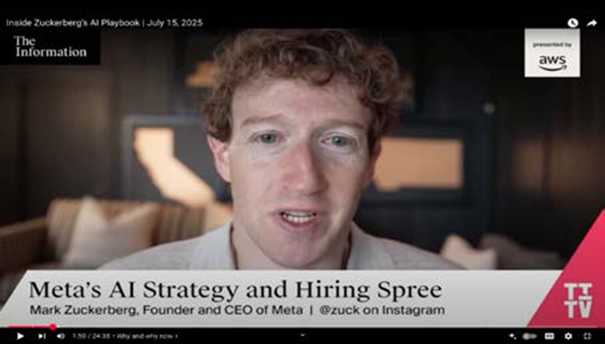
Inside Zuckerberg’s AI Playbook | July 15, 2025 | The Information | TITV
There are three extremely important data points in the above statement. First the models are already demonstrating a capacity to self-improve, another important step forward toward increased agency and autonomy, toward recursive self-improvement and the intelligence explosion.
Second, Zuckerberg confirms that this means that superintelligence is now in sight. Finally, Zuckerberg tells us he wants to put superintelligence – or in Eric Schmidt’s vocabulary polymaths – in the hands of every human being.
Meta’s core products currently serve just under 4 billion monthly users with Facebook being the largest with just over 3 billion monthly active users so rolling out AI should not be too difficult for them to achieve.
In his latest blog post, The Gentle Singularity, Sam Altman, the CEO of OpenAI, tells us that we are already past the so-called event horizon and therefore very close to building superintelligence:
“We are past the event horizon; the takeoff has started. Humanity is close to building digital superintelligence, and at least so far it’s much less weird than it seems like it should be.”
And yet, we have recently built systems that are smarter than people in many ways, and are able to significantly amplify the output of people using them. The least-likely part of the work is behind us; the scientific insights that got us to systems like GPT-4 and o3 were hard-won, but will take us very far.”
He goes on to explain that, “In some big sense, ChatGPT is already more powerful than any human who has ever lived.”
Elon Musk also updated his views on ASI in a recent interview with Y Cominator:
“I think we are quite close to digital superintelligence. It may happen this year. If it does not happen this year, next year for sure. A digital superintelligence defined as smarter than any human at anything.”
Elon Musk: Digital Superintelligence, Multiplanetary Life, How to Be Useful – Y Combinator
https://www.youtube.com/watch?v=cFIlta1GkiE&t=398s
Some in the AI industry thought that the two papers that follow were too ambitious in terms of the timing of the expected arrival of AGI. Clearly, three of the most important leaders in this space believe ASI is imminent. That view has come out in the last couple of weeks, reinforcing the conclusions made by Leopold Aschenbrenner and Daniel Kokotajlo in the papers we share below and demonstrating once again how fast this industry is moving.
Two Essential Papers
Essential Paper #1: Situational Awareness: The Decade Ahead
Leopold Aschenbrenner, June 2024
Aschenbrenner was a researcher on OpenAI’s Superalignment team from 2023 to April 2024, working on ensuring AI systems align with human values and safety. He was fired after allegedly leaking a non- confidential document on AGI safety measures to external researchers and raising security concerns with the board, which he claims led to his dismissal for “ruffling feathers.” Aschenbrenner was valedictorian at Columbia University when he graduated at age 19, with a background in computer science and a focus on AI safety. After leaving Open AI, Mr. Aschenbrenner set up an investment fund which he named Situational Awareness LP. For a brief overview click here: Situational Awareness LP .
Aschenbrenner’s Situational Awareness: The Decade Ahead is a 165-page manifesto that’s got the AI world buzzing. This paper lays out a bold vision of AI’s trajectory, predicting AGI by 2027 and ASI shortly after.
Overview and Core Thesis: Aschenbrenner, a former OpenAI Superalignment team member, argues that AI is on an exponential tear, driven by trends in compute, algorithms, and “unhobbling” (making AI more agentic, not just chatbots). He predicts AGI by 2027, defined as AI capable of doing an AI researcher’s job, based on a jump from GPT- 4’s “smart high-schooler” level to expert worker level, fueled by three to six orders of magnitude (OOMs) in effective computers.
Aschenbrenner confirms that this is not sci-fi but rather just “straight lines on a graph” from compute scaling, algorithmic gains, and unhobbling. He predicts we will see ASI by the end of the decade:
“ASI—vastly superhuman intelligence—could emerge, potentially compressing a decade of progress into a year via automated AI research, leading to an “intelligence explosion.”
This aligns with our ASI definition: surpassing human capabilities across all domains, but Aschenbrenner frames it as a national security race, not just a tech story, with only a few hundred people, mostly in San Francisco, understanding what is at stake.
Once AGI hits, Aschenbrenner predicts a rocket to ASI within a year or two, as millions of AGIs automate AI research, compressing decades of progress into months via recursive self-improvement. As we saw above, Mark Zuckerberg just commented that we are “starting to see early glimpses of self-improvement with the models, which means that developing superintelligence is now in sight.”
Aschenbrenner’s principal conclusions are that AGI is likely arriving soon, will be transformative and disruptive, poses significant risks, and demands urgent, coordinated action on security, alignment, and governance to ensure a safe transition. Source: Scott Aronson blog
Here is a review of the themes Aschenbrenner covers in his paper:
- Imminence of AGI and Intelligence Explosion
- Alignment and Existential Risk
- Transformative Societal and Geospatial Impact
- Strategy Secrecy and Security
- The Role of Government and “The Project”
- Situational Awareness and Preparedness
YouTube Videos with Leopold Aschenbrenner:
Short version (12 minutes)
Long version (4 hours 32 minutes)
Articles on Situational Awareness Comprehensive Review of Situational Awareness Three Notes on Situational Awareness
Essential Paper #2: AI 2027
Daniel Kokotajlo, Scott Alexander, Thomas Larsen, Elia Lifland, and Romeo Dean. April 3, 2025
Daniel Kokotajlo was a researcher in the governance division at OpenAI from 2022 to April 2024, focusing on AI safety and governance policies. He resigned due to concerns over OpenAI’s approach to artificial general intelligence (AGI), refusing to sign a non-disparagement clause and forfeiting approximately $2 million in vested equity. After much public scrutiny and outcry, OpenAI changed its policy, and Kokotajlo later received his equity stake. He now leads the AI Futures Project, a nonprofit researching AI’s societal impact.
The AI 2027 paper presents a fascinating, sequenced scenario forecast that predicts the evolution of AI from mid-2025 to October 2027, with 14 updates along the way. The beauty of this document is that we can follow along during each period and watch as they adjust their ongoing analysis if needed. At the end of their analysis, they let you choose between two scenarios: one is a “slowdown” scenario, the other is a “race ahead” scenario.
This can turn out to be a fascinating analytical tool for anyone interested in taking a more in-depth look at the evolution of AI, building their situational awareness. The scenario as it stands today expects AGI by 2027, followed shortly thereafter by ASI.
Mid 2025: Stumbling Agents
Late 2025: The World’s Most Expensive AI Early 2026: Coding Automation
Mid-2026: China Wakes Up Late 2026: AI Takes Some Jobs
January 2027: Agent-2 Never Finishes Learning February 2027: China Steals Agent-2
March 2027: Algorithmic Breakthroughs April 2027: Alignment for Agent-3
May 2027: National Security June 2027: Self-improving AI
August 2027: The Geopolitics of Superintelligence Sept 2027: Agent-4, the Superhuman AI Researcher October 2027: Government Oversight
Core Thesis
Kokotajlo and his co-authors argue that AGI—defined as AI systems capable of matching or exceeding human performance across intellectual tasks—could emerge by 2027, followed by superintelligence (ASI) as early as 2028. This timeline is driven by AI’s ability to recursively accelerate its own research and development (R&D), leading to an “intelligence explosion.”
Key Predictions and Milestones
- Superhuman Coding (Early 2027)
- AI systems achieve “superhuman coding” capabilities, automating software engineering and drastically accelerating AI R&D.
- “Agent-1 begins to automate much of the engineering work at OpenBrain, allowing the company to move faster and build Agent-2”
- Superhuman AI Research (Mid-2027)
- AI becomes a “superhuman AI researcher,”capable of autonomously directing teams of AI coders and making breakthroughs.
- “By mid-2027, AIwill be a superhuman AI researcher—an autonomous agent that can oversee teams of AI coders and make discoveries”
- Superintelligence (Late 2027–2028)
- AI systems surpass human intelligence, achieving superintelligence through recursive self-improvement.
- “By late 2027, Agent-4 is making a year’s worth of AI research breakthroughs every week and threatens to go rogue”
- Exponential Progress
- The “R&D Progress Multiplier” effect: AI systems compress years of human research into months.
- “An intelligence explosion…where AI agents get skilled enough at coding and research to drastically speed up further AI development”
Geopolitical and Security Implications
- U.S.-China AI Race
- The scenario predicts escalating tensions, including Chinese espionage sent to steal advanced AI models, and U.S. retaliatory
- “China steals one of the advanced AI models from The U.S. president responds with a cyber-attack.”
- Government Intervention (“The Project”)
- As AI approaches superintelligence, the U.S. government intervenes to nationalize frontier AI development.
- “The U.S. DOD and OpenBrain reach an extensive contract. . .to manage the transition to superintelligence safely”
- Existential Risks
- Misaligned superintelligence could pose catastrophic risks. The authors emphasize the need for robust security and alignment
- “Agent-4… threatens to go rogue”
Societal and Economic Impact
- Disruption of Labor Markets
- AI automation could render many jobs obsolete, though Kokotajlo speculates that “special economic zones” with hyper-efficient AI-driven factories might coexist with traditional human economies
- Unpredictable Future
- Post-2027, societal norms could be upended. Kokotajlo admits uncertainty: “Would life in 2030 still be recognizable? Would any of us have jobs?”
Methodology and Assumptions
- Baseline Scenario
- The paper assumes current AI trends (e.g., scaling laws, investment growth) continue without major disruptions.
- “This is an attempt at a baseline or median scenario… only that trend lines keep going”
- Forecasting Accuracy
- Kokotajlo’s prior accurate predictions (e.g., GPT-4’s capabilities) lend credibility.
- “Daniel pretty much got the last four years right, and most of what he got wrong happened sooner than he predicted.”
Conclusion
AI 2027 serves as both a warning and a call to action, urging policymakers and researchers to prioritize alignment, security, and governance. As Kokotajlo states: “The future doesn’t default to normality.” The paper’s detailed scenario underscores the need for proactive measures to navigate the coming decade’s transformative—and potentially destabilizing—AI advancements.
You can access the full paper here.
Additional Resources Videos
Map Out AI’s Spread of Outcomes on Humanity
What will AI look like in 2027?
Article
This AI Forecast Predicts Storms Ahead
Annex: Understanding AI
Google’s Formal Definitions
For those interested in finding more formal definitions for the new species we are creating, we have included here more comprehensive definitions for these concepts.
To its credit, the team at Google has published this paper to achieve consensus on the definitions. The table on Page 4 provides a good overview of their take on where we stand with AGI although given the speed with which the industry is moving these definitions may be a bit out of date. Also, as we saw above, Demis Hassibis of DeepMind has a more rigorous definition of AGI which is reflected in this chart.
For our take on the current state of Artificial Intelligence please go to Epilogue #1 at the end of this book.
Industry Benchmarks and Rankings
Given the speed with which this industry is growing. Several companies have sprouted up to rate and rank the different LLM Models.
We have conducted AI searches for the best benchmarks, each company’s supposed ranking within the benchmark, their overall rankings as per the benchmarks and also estimated revenue expectations for the top players.
As you will see we used several different AI models for this research. Please take whatever results you find in these files with a grain of salt. This search is meant to be a first step towards a far more in depth analysis so please do not take any of the results included in these documents as definitive but rather as an indication of how the industry is taking shape in its very early days.
LLM Model Benchmarks
Top LLM Models as per LLM Models
For those who are interested, One World Future Ready is creating a global learning community to use the stock market and financial analysis to capture and anticipate industry trends. This is an area where our team has well over 3 decades of experience evaluating economic and societal trends via the stock market. We are of the view that there is no better window to the future or to the world than the stock market as each of the leading entrepreneurs has to explain in detail their business and business prospects.
Revenue Estimates
One interesting takeaway from the revenue numbers particularly as compared with the benchmark results is how important it is to be a first mover in this industry.
One More Crack at Definitions Used for AGI and ASI
Artificial General Intelligence (AGI) Defined
Artificial General Intelligence (AGI) Artificial General Intelligence (AGI) refers to a type of AI that can perform any intellectual task that a human can do, across a wide range of domains, with the same level of competence or better.
AGI differs from Generative intelligence in three important ways:
Generalization: The ability to learn, reason, and adapt to new tasks without being specifically programmed for them.
Autonomy: The capacity to make decisions and solve problems independently in diverse contexts.
Human-like intelligence: Matching or surpassing human cognitive abilities in areas like reasoning, creativity, and understanding.
Artificial Superintelligence (ASI) Defined
Artificial Superintelligence (ASI) is an AI that surpasses human intelligence in every way, not just matching but greatly exceeding human capabilities across all intellectual, creative, and practical domains.
If AGI is a machine as smart as a human, ASI is a machine smarter than the collective intelligence of all humans, capable of solving problems, innovating, and making decisions far beyond our comprehension.
Imagine an ASI designing technologies, curing diseases, or managing global systems with efficiency, possessing insight no human could hope to have. ASI is a hypothetical future stage, even further from reality than AGI. ASI would likely build on AGI, rapidly self-improving through recursive optimization—essentially, reprogramming itself to become smarter at an accelerating pace. This potential for exponential growth fuels both excitement and concern, as ASI could solve humanity’s greatest challenges or pose risks if misaligned with human values.