As mentioned in our introduction one of the goals with this book is to bring readers key concepts without which it is virtually impossible to understand today’s world. One such concept is understanding the importance of exponential change as compared with linear change.
Indeed, we believe that it is impossible to understand today’s world using a linear mindset. 21st-century Citizen Leaders understand that technological change is exponential in nature, and therefore, they work hard to govern with an exponential rather than linear mindset. 21st Century Educational Leaders see the potential for a world of abundance and understand that exponential technological change has the potential to make a world of Super Abundance available to us and are working hard to bring that understanding to their students.
Those who have a 21st-century mindset understand that to effectively govern today’s world, one needs an exponential mindset. They understand that many of the challenges we face today occur because we are attempting to govern a world of exponential change with a linear mindset.
This mismatch or disconnect was made clear by Google CEO Sundar on the television newsmagazine 60 Minutes, where he told interviewer Scott Pelley that humanity is not ready for the dramatic changes in technology because of the mismatch between humans’ capacity to manage change vs. the speed of technological change:
Scott Pelley: Do you think society is prepared for what is coming?
Sinar Pinchai: There are two ways I think about it. On the one hand, I feel no, because of the pace at which we can think and adapt as societal institutions compared to the pace at which technology is evolving, there seems to be a mismatch…
21st Century Citizen leaders and educators understand that this mismatch is growing and are searching for ways to close the gap.
Ray Kurzweil’s Law of Accelerating Returns
The reason it is so important to understand the concept of exponentials in today’s world is that technology changes at an exponential rate rather than at a linear rate as Ray Kurzweil pointed out as he developed his Law of Accelerating Returns.
According to Bill Gates, “Ray Kurzweil is the best person I know at predicting the future of artificial intelligence. At a time when most of the world was still struggling to understand technology’s impact, Kurzweil made what seemed like wild predictions as to where technology was headed. Over the years, Kurzweil’s predictions have proven accurate time and again.”
We believe Kurzweil’s predictive success owes to his development of a framework he calls the law of accelerating returns. His key insight has been to recognize that technological change occurs at an exponential or even double-exponential rate. As a result, he asserts that those who take the common-sense, linear view almost always underestimate the pace of change, while Kurzweil’s seemingly outlandish predictions have proved to be extremely accurate. The essence of Kurzweil’s law of accelerating returns applies not just to technology. He believes that his law is useful in explaining biological evolution as well. At the core of this theory is the idea that whenever a technology approaches some kind of barrier, a new technology will be invented by human beings to allow us to cross that barrier. Kurzweil cites numerous examples from all walks of life to substantiate his assertions. He predicts that such paradigm shifts have and will continue to become increasingly common, leading to “technological change so rapid and profound it represents a rupture in the fabric of human history.” Kurzweil calls this event horizon the Singularity. We will discuss the Singularity more fully below, but here is how Kurzweil defines his law of accelerating returns:
“Evolution applies positive feedback in that the more capable methods resulting from one stage of evolutionary progress are used to create the next stage. As a result, the rate of progress of an evolutionary process increases exponentially over time. Over time, the “order” of the information embedded in the evolutionary process (i.e., the measure of how well the information fits a purpose, which in evolution is survival) increases. A correlate of the above observation is that the “returns” of an evolutionary process (e.g., the speed, cost-effectiveness, or overall “power” of a process) increase exponentially over time. In another positive feedback loop, as a particular evolutionary process (e.g., computation) becomes more effective (e.g., cost- effective), greater resources are deployed toward the further progress of that process. This results in a second level of exponential growth (i.e., the rate of exponential growth itself grows exponentially).
“Biological evolution is one such evolutionary process. Technological evolution is another such evolutionary process. Indeed, the emergence of the first technology-creating species resulted in the new evolutionary process of technology. Therefore, technological evolution is an outgrowth of–and a continuation of–biological evolution. A specific paradigm (a method or approach to solving a problem, e.g., shrinking transistors on an integrated circuit as an approach to making more powerful computers) provides exponential growth until the method exhausts its potential. When this happens, a paradigm shift (i.e., a fundamental change in the approach) occurs, which enables exponential growth to continue.”
The complete essay is here: Ray Kurzweil’s Law of Accelerating Returns
Understanding Exponentials is Not Intuitive
30 Exponential Steps = 26 Earthly Circumnavigations
So long as we attempt to govern a world of exponential change with a linear mindset, we will fail. Why? The answer is simple and readily understood with a clear example: In a linear world, a world that has been our everyday experience for tens of thousands of years, when we take thirty steps we have a good idea of the distance we will cover: with 30 steps, I will cover a distance of about 30 yards, or from the front of the classroom to the back of the classroom.
Understanding exponentials is not intuitive and counter to our lived experience of the last 10,000 years. Thirty doublings— 1, 2, 4, 8, 16, 32, 64, 128, and so on— will yield one billion (or 1,073,741,824 to be exact).
How far can I walk with one billion steps? From New York to Nanjing? Circumnavigate the globe once? Five times? No. Twenty-six times! That’s right. Thirty exponential steps, or thirty doublings, will take us around the Earth twenty-six times.
How do we begin to compare a world of 30 yards or meters with over 1 billion yards or meters? How do we compare walking from the front of the room to the back of the room with a world where we can circumnavigate the globe 26 times?
The futurists tell us that we need to prepare our youth for a lifetime where they will experience the equivalent of 20,000 years of change, or 10 times more change than has occurred since the birth of Christ. (Please see Chapter One Appendix for visual ways to understand exponentials.)
Today’s Education Challenge: Closing the Growing Exponential Gap
We have long maintained that educators haver never being challenged as they are today, being asked to prepare students for a world that no one understands, for jobs that do not exist.
In this YouTube video, engineer Peter H. Diamandis explains that we are moving from a linear world to a world of exponential technological change.
In this graph from the video, Diamandis, who can credibly be referred to as the Godfather of abundance thinking, provides us with a picture of the growing and accelerating disconnect between exponential technological change and our linear mindsets. He then correctly defines this growing gap as one of today’s foremost educational challenges.
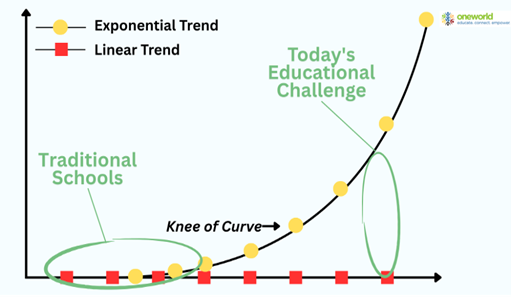
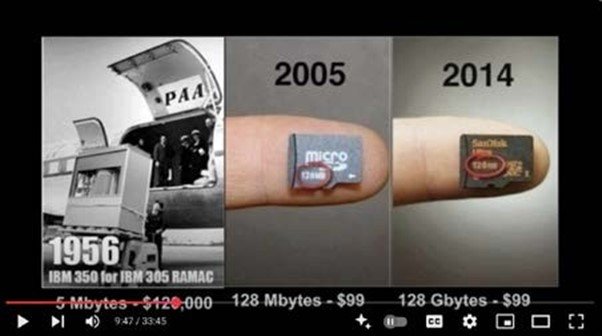
You can see the chart at minute 2:40 of the video. We recommend watching the first 3:10 of the video and then fast forward and watch from minute 9:14 to minute 10:10 to get the best visual of exponential technological change you will ever see which we have included above: https://www.youtube.com/watch?v=jndZviHWE28&t=2s
This growing disconnect is not new; according to economist Jeffrey Sachs, this disconnect has been growing ever since the launch of the scientific and Industrial Revolutions, as he explains in his book Common Wealth:
“For the past 200 years, technology and demography have consistently run ahead of deeper social understanding. Industrialization and science have created a pace of change unprecedented in human history. Philosophers, politicians, artists, and economists must constantly scramble to catch up with contemporaneous social conditions. Our social philosophies, as a result, consistently lag behind present realities.”
Author and Columnist Thomas Friedman, in his book Thank You for Being Late, makes the same point more emphatically when he quotes Eric “Astro” Teller, the CEO of Google’s research and development lab, as saying:
“…people hear about advances such as robotic surgery, gene editing, cloning, or artificial intelligence, but have no idea where these developments will take us.
“None of us have the capacity to deeply comprehend more than any one of these fields – the sum of human knowledge has far outstripped any single individual’s capacity to learn – and even the experts in these fields can’t predict what will happen in the next decade or century.”
Somehow, we need to close the gap in our thinking to effectively address the changes coming our way because it seems clear that the pace of change will continue to accelerate.
We believe that the better we understand the nature of exponentials, the greater is our potential for filling this gap. Indeed, understanding the impact of exponential technological change is essential to understanding the 21st Century and to building a 21st Century mindset.
Understanding the “Knee of the Curve”: Where 97% of Change Takes Place
One important point to understand about exponential change is that over the first twenty to twenty-five doublings, not very much happens, as we see this with another example where we compare the doubling of a penny every day for thirty days with the prospect of receiving $4 million at the end of those same thirty days.
We ask our students: would they rather have a penny that doubles every day for thirty days, or $4 million? We repeat the question after ten days, when a penny doubled is only worth $5.12, and again after twenty days, when a penny doubled is only worth $5,242.88, and once again after twenty-five doublings, when the penny has increased in value to $167,772.16. Those who stick with the penny doubling after thirty days are rewarded with $5,368,709.12.
The really important point to be made here is that 97% of the change takes place in the last five doublings. This is one of the most important points to take away from this book. The reason is simple: technological change is exponential. Understanding that we may not see the full impact of exponential change until it is too late may very well be what is happening to our world with Artificial Intelligence
As we discuss in future chapters, we may no longer be at the knee or the curve. We are at the neck of the curve, where the pace of change is starting to look infinite, approaching a straight line upward. Hang on to your seatbelts! Humanity has never experienced anything like this rate of change.
Moore’s Law & The Potential for a World of Abundance: Where Your Cars can Cost Four Cents!
The impact of this profound change is everywhere. One clear example has been Moore’s law. In 1965, Gordon Moore, the co-founder of computer chip maker Intel, predicted that computing capacity would double every 24 months at the same price. His prediction has largely held for fifty years, As a result, most of us have more computing capacity in our hands than in the Apollo 11 spacecraft that landed on the moon in 1969.
In 2015, when Intel was celebrating the fiftieth anniversary of Gordon Moore’s successful prediction, the company’s CEO, Brian Krzanich, tried to put the profundity of this change in perspective:
“Were a 1971 Volkswagen Beetle car to undergo the same transformation…it would travel 300,000 miles an hour, get 2 million miles per gallon, and cost four cents.”
How would you like to buy a car for four cents?
The Next Ten Years: A Million-Fold Increase in AI Compute
Our global society has had difficulty keeping up with Moore’s law, where computing capacity has doubled every 24 months, leading to a 32-fold increase in computing capacity when compounded.
It now seems as if AI computing is doubling about every six months.
Those who understand the power of exponential change will understand that a doubling every six months over the next decade translates into a one-million-fold increase over ten years, assuming this pace of change continues.
How in the world would we keep up with a million-fold increase in computing capacity if we had difficulty keeping up with a 32-times increase in previous decades?
Quantum Computing: 5 minutes vs 725 Trillion Big Bangs
As if a million-fold increase in AI computing was not enough to absorb, there is a whole new world in quantum computing where quantum computers can do certain calculations in minutes that the best computers today would take billions of years to solve or more.
For example, Google’s Willow quantum chip, unveiled in December 2024, performed a benchmark computation known as Random Circuit Sampling (RCS) in under five minutes. Google estimated that the same RCS computation would take one of today’s fastest supercomputers, approximately 10 septillion years (10^25 years) to complete.
Let’s put that number in perspective. The Big Bang occurred 13.8 billion years ago. How many Big Bangs could fit into 10 septillion years? It turns out that the number is 725 trillion. So basically, our new quantum computers can do complex calculations in 5 minutes as compared with 725 trillion Big Bangs!!
To be clear, quantum computers are not expected to have widespread practical use in the near term because they continue to have high error rates and are therefore less scalable and are more costly. The expectation going forward is as these problems are resolved quantum computers will revolutionize fields requiring immense computational power like weather systems.
As we will see in later chapters, the top foundational model companies are already complaining that the whole of human knowledge is insufficient for them to train their models and are therefore looking to create reliable synthetic data.
One area where quantum computers have the potential to impact the development of AI in the not too distant future would be to create synthetic data. By leveraging their unique computational capabilities they could generate high-quality, realistic datasets that mimic real- world data distributions.
For us the bottom line is clear. In a world of great uncertainty relative to the expected impact from a million-fold increase in AI computers over one decade compared with Moore’s Law of 32-fold increase in one decade, the promise and challenge emanating from Quantum Computing greatly increases the level of uncertainty.
Does anyone really know how quantum computing and AI will interact? Would it be a safe bet that the quantum computing revolution has the potential to accelerate the million-fold increase in AI compute coming our way over the next 10 to 14 years?
That combination clearly has the potential to create the Singularity event horizon predicted by Kurzweil and Vinge and Von Neuman beyond which we cannot see.
I don’t know about you, but we are having difficulty visualizing the comparison between a calculation done in five minutes by Willow and the 725 trillion Big Bangs it would take for today’s top supercomputers to solve.
You can read more about the opportunities and challenges arising from quantum computing here:
For more on this topic click here: Quantum Computing & Google’s Willow
Videos Explaining Quantum and Willow meet Julian Kelly from Google Meet Willow, our state-of-the-art quantum chip minutes 6:38 with Julian Kelly
Video: https://www.youtube.com/watch?v=W7ppd_RY-UE
Third Party Explanations
Google Quantum AI 9:38 minutes
Video: https://www.youtube.com/watch?v=kRIjd65ihqI
Google’s New Quantum Chip SHOCKED THE WORLD – 10 Million Times More Powerful!
Video: https://www.youtube.com/watch?v=NB9K4CoYSIM 9:28 Minutes
Endgame Quantum Computing Unlocked?
Video: https://www.youtube.com/watch?v=5ly1yhu3hG4
Understanding Exponential Change: What’s Next? No One Knows.
Children entering school today will graduate from high school in 2038; if they matriculate to college, most will graduate in 2042. Can anyone tell us today what our world is going to look like in 2042?
The honest answer is that nobody knows what comes next. We have long explained that educators are being tasked with the impossible. They are asked to educate K-12 students for a world that no one understands, for jobs that do not yet exist. With the onset of AI and ChatGPT, that comment has never been truer.
Indeed, Yuval Noah Harari, the global thought leader and author of Sapiens and Homo Deus, explains that for the first time in human history, adults are no longer a good guide to the future. Not because they are not dedicated to the well-being of their children, but rather because no one has ever experienced a pace of change like the pace of change we are experiencing today.
In this video, Harari explains that he has written his most recent book, Unstoppable, for kids, so that they may understand the world around them, particularly at this crucial time in human history, where“ …for the first time, adults are not really good guides for the future of these kids. We, for the first time, have no idea what the world will look like when the children of today are themselves grown up. Nobody knows what the economy or the job market or what society will look like in 10 or 20 years.”

In this interview with Stephen Colbert, Harari explains once again that no one understands what the world will look like in ten to twenty years, and, therefore, nobody today has any idea what to teach young people that will still be relevant in twenty years

What is clear to us today is that more than any other time in human history, we are experiencing a rate of change that has never occurred. The only way to understand today’s rate of change is to understand exponentials and exponential rates of change. The reason is simple, as we explain in the next chapter: technological change is exponential. There is no way anyone can understand our 21st-century world without understanding exponential change.
We hope that the information above has helped the reader in their quest to understand exponentials. To continue to aid in your understanding, we have included in the appendix below some videos that help to understand the exponential rate of change.
Appendix: Tools to Understand Exponential Change
Understanding Exponentials
Each of these YouTube videos below explains exponentials using different frameworks.
Video #1: Aussies Explaining Starting with Lilies on a Pond
Video #2: Peter Diamandis compares 30 linear steps with 30 exponential steps
How far can I walk with 30 linear steps? With 30 exponential steps?
Video #3: Ambalappuzha and the Invention of Chess
Video #4: Doubling a Penny a Day for 30 Days
Would you rather be given a penny that doubles every day for 30 days or $2.5 million?
10 days: 5.12
20 days: 5,242.88
Exponentials by the Numbers contains the numbers corresponding to a penny doubling every day, of Moore’s Law vs the next ten years, and a simple doubling 30 times, reaching a billion.