From Homo Technicus to Homo Sapiens
Introduction
Many of the challenges we face today are a result of our success as a species or more accurately our success as Homo Technicus. There would be no climate change challenge if we had continued on the same path we had been on for the previous 200,000 years as the number of inhabitants would be far less as would the pressure we put on the environment coming from the technologies we have built up over the last 125 years.
The other existential risks we are facing, would also not be a worry except for the dramatic technological advances we have made over the last 125 years. Technological advances as we have seen are accelerating daily, such that today will be the slowest day you will ever live unless we face some form of civilizational collapse.
The reason the time that we are living is so important to the future of humanity is that the pace of technological change has reached a speed that challenges our societal capacity to manage that change. As we have seen we all too often attempt to apply linear mindsets to a world of exponential technological change.
The goal of this chapter is to make clear how successful Homo Technicus has been and, to make clear that we have reached a pace of technological change that will overwhelm us if we do not act urgently to address the technology tsunami we have created.
We can no longer kick the can down the road, as polymath after polymath have made clear the technology event horizon is imminent. The accumulating technological change of the last 125 years is coming to a head. What has become abundantly clear is that humanity needs to find a way to unite and manage the increasingly powerful technologies we have created. Technologies that have brought us to crossroads, to the brink of extinction or unprecedented success.
In this chapter, we first share with you how we arrived at this important moment – 125 years of accelerating technological change – and then call for a new human wisdom commensurate with our technology and the name of our species. We need to urgently move from Homo Technicus to Homo Sapiens.
125 Years of Accelerating Technological Change
In the same manner that the Charles Krauthammer article fundamentally changed or informed our view of the world in terms of generating a concern resulting from the Fermi Paradox, the first 90 seconds of the TED Talk by William MacAskill fundamentally changed our understanding of history.
As you can see in the chart below, for the first 200,000 years of our existence, nothing happened, nothing really changed, and most everyone lived a subsistence lifestyle earning the equivalent of about one dollar a day. And then, in MacAskill’s words, something extraordinary happened: the Scientific and Industrial Revolutions, and the flat graph we saw transformed into a straight vertical line. MacAskill explains that “what this graph means is that in terms of power to change the world, we live in an unprecedented time in human history, and I believe our ethical understanding hasn’t caught up with this fact. The Scientific and Industrial Revolutions transformed both our understanding of the world and our ability to alter it. What we need is an ethical revolution so that we can work out how to use this tremendous bounty of resources to improve the world.”

Homo Technicus: The Scientific and Industrial Revolutions: The Last 125 Years
Over the last 125 years, our species— driven by Homo Technicus— has been extremely successful. Since the year 1900, the global population has increased by more than 400%, from 1.6 billion to 8.2 billion.
The increase in global wealth as measured by GDP has been even more pronounced. In constant US dollars, global GDP has gone from about $3 trillion in 1900 to about $110 trillion in 2025, representing a 36x fold increase. The dramatic productivity improvements translated into an eightfold increase in per capita GDP.
Estimated global population from 10,000BCE to 2100
(in millions)
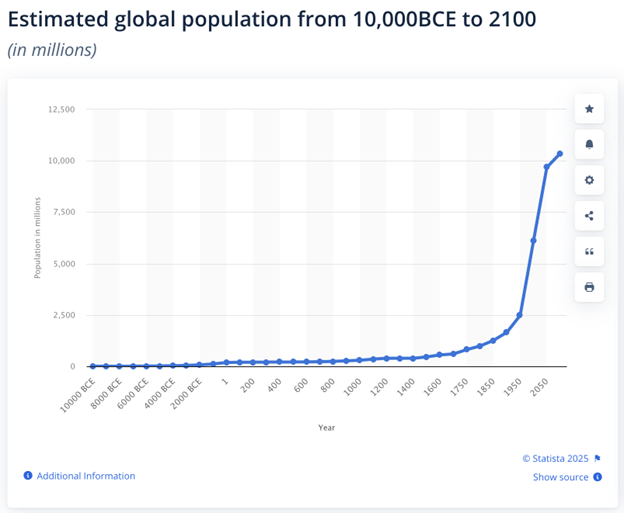
No one can have any doubt that the Scientific and Industrial Revolutions have had a very positive impact on humanity. Our species has quadrupled in size, we now inhabit almost every corner of the planet, and on a per capita basis, every individual alive today is eight times wealthier than the average person in 1900.
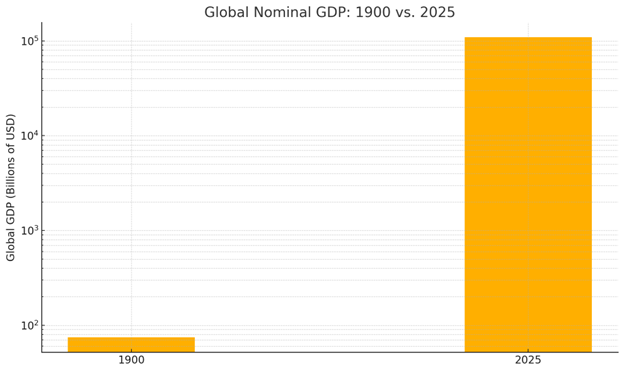
This is not to say we do not have important problems with hunger, poverty, and the distribution of this wealth within and among countries. But if we take a big step back and look at the evolution of humankind over the last 250 years, we have made great strides in terms of growing our global population and generating a vast amount of wealth for all. As it relates to Homo Technicus, (Technical Human) we have been enormously successful.
This increased wealth in large part owes to the tools and technology we have built up over the last 250 years, from the steam engine right up to ChatGPT: Our Tools over the Last 250 years
The use of these tools has combined to transform our world in ways no one could imagine in 1900. Imagine the response you would get if you tried to explain someone from 1900, living in a city full of manure, that horses would be gone in twenty years, that human beings would learn to fly, walk on the moon, split the atom, and would be building a new digital species that would eliminate poverty, hunger and the need to work?
It would have been virtually impossible for the great majority alive in 1900 to imagine the profound change in the quality of life that occurred over these last 125 years. In 1900, most of the world’s population lived in extreme poverty, with limited access to education, clean water, medical care, and electricity. In 1900, less than 10% of the global population had access to electricity, with literacy rates of about 20%. Today, more than 90% of the world has access to electricity, and the global literacy rate exceeds 85%.
Infectious diseases, including tuberculosis, smallpox, and cholera, were common causes of death in 1900. Child mortality was high, and many people labored long hours in agriculture or factories under dangerous conditions, with an average life expectancy of thirty-two. By contrast, 2025 offers a world where billions have access to modern healthcare, digital technology, improved sanitation, and basic education. Vaccines, antibiotics, and advances in surgery have transformed survival and well-being, with an average life expectancy of 73 years.
Beyond survival, the nature of life itself has changed. In 1900, most people had never traveled far from home, information moved slowly, and few had access to books, let alone the internet, which did not exist. In 2025, billions of people carry smartphones, connect instantly across the globe, and live in urban environments shaped by science and technology. While challenges remain—especially inequality and climate pressures—the average human today lives a life of greater opportunity, safety, and comfort than their ancestors could have imagined.
The Post-Printing Press Mindset Revolutions
One of the big questions we need to ask ourselves is, how did this happen and why did this happen when it did?
We believe the spark that changed our world started with the invention of the printing press, which converged with the emergence of a new mindset, a new way of thinking that started with the Renaissance and evolved into the Scientific Revolution.
In our view, the transformational change brought about first by the Renaissance and then by the Scientific and Industrial Revolutions was more than anything a change of mindset, where a new generation of thinkers sharing ideas with newly printed books challenged centuries of inherited wisdom. The Renaissance and the Scientific Revolution taught humanity how to think differently breaking with past dogma with a view to understanding our world via observation and mathematics. This change in thinking lead to revolutionary ideas like Copernicus’ heliocentric model and Newton’s laws of motion. We urgently need that same kind of mindset change today.
If the Scientific Revolution was about understanding nature, the Industrial Revolution was about harnessing it. Powered by coal, steam, and capital, 18th- and 19th-century Europe saw the birth of factories, the rise of machines, and the transformation of rural life into urban industry. Entrepreneurs like James Watt, didn’t just invent things—they built systems to produce, replicate, and profit from them at scale.
This too, was a mindset revolution. The Industrial Age introduced a new way of thinking: optimize, systematize, and scale. It turned labor into a commodity, time into money, and nature into “resources.” It encouraged humans to see the world not as a fixed order, but as raw material to be organized, improved, and exploited. The scientific mindset was still present, but it was now embedded in a framework of economic calculation and industrial growth.
The mid-20th century introduced a quieter, but equally profound transformation. The invention of the computer, followed by the microchip, the internet, and global networks, created an entirely new plane of reality: the digital realm. Here, information could be copied, manipulated, and shared at the speed of light.
The Digital Revolution shifted our technology mindset again. It encouraged us to think in terms of systems, data, and networks. It introduced the idea that mental labor—calculation, analysis, even creativity—could be replicated in silicon. The result was a world where knowledge was no longer stored in books or brains alone, but distributed across clouds, platforms, and screens.
Today, we are living through another technology mindset revolution— As we have been discussing. Artificial Intelligence is not just an extension of the Digital Revolution; it represents a fundamental shift in our relationship to thinking itself. We are no longer just using machines to store or process information. We are now designing systems that can perceive, reason, learn, and act, eventually on their own.
However, as we have been explaining, the emergence of autonomous agents, generative models, and decision-making systems is far more transformative than any previous technology. The digital species we are creating forces us to reconsider what it means to be intelligent, creative, or even human.
This revolution is still young. Its risks are real, and its trajectory is uncertain. But its potential to unlock abundance, extend cognition, and reimagine human flourishing is unlike anything that came before it.
The profundity of the transformation requires a mindset revolution equivalent to the fundamental change in mindset that emerged with our first Renaissance.
From Here to Abundance: The New Human Condition
These mindset revolutions are not merely historical, they have fundamentally changed our evolution as a species.
The Renaissance and Scientific Revolutions taught us to question. Then the launch of the Industrial Revolution unleashed new technological mindset revolutions as each technology evolved from the steam engine, to electricity, to the telephone to the automobile to the airplane, the splitting of the atom, to the digital revolution to the computer/internet revolution to the AI revolution.
It is beyond the scope of this book to match these technological mindsets and revolution with the global, geo-political infrastructure of the day but we can comment on the speed with which each technology was taken up and how fast they accelerated across the globe.
As we saw in Chapter 3, the speed at wich technologies are being taken up is accelerating rapidly. For example as we discussed, it took 35 years for 25% of the US population to adopt telephones, 30 years to adopt electricity, 25 years for automobiles, 16 years for computers, 7 years for the internet, 4 years for Smartphones, and 6 months for ChatGPT.
Again we find it useful to use the stock market as a window to the world as the stock market provides us with a unique window to the world and to the future.
For example, another way to evaluate the accelerating pace of change is to look at the average lifespan of a Standard Poor’s 500 company. According to a McKinsey study, the average life-span of S and P companies has gone from 61 years in 1958 to about 16 years in 2021.
Source: Shrinking Life Cycle of an S&P 500 Company: May 27, 2021 by Nik Schuurmans, https://www.pureportfolios.com/shrinking-life-cycle-of-an- sp-500-company/
Another phenomen that can be viewed from the Wall Street perspective is to see how fundamentally different the big tech companies of today are as compared with industrial companies. They have huge cash margins that to date have not required the same kind of capital investment industrial era companies need to build out new factories.
They can therefore rapidly build out global enterprises that extend across the world targeting virtually the whole of humanity. For example, the Meta (Facebook) companies currently serve over 4 billion monthly active users.
Moreover, today they can use their huge cashflows to invest in billions if not trillions of dollars in AI as they seek to build on their first mover advantage.
For us, one of the best ways to understand the dramatic pace of change and accompanying wealth creation is to understand that it took the whole of humanity or 12,000 years to create the first company worth one trillion dollars. That accolade was reserved for Apple who became the world’s first trillion dollar company on August 2nd, 2018.
However, the really interesting point from our perspective is that it only took Apple another 2 years to add another trillion dollars in value and another 1.5 years to reach the $3 trillion dollar mark. That means that Apple was able to add $2 trillion dollars in value in 3.5 years as compared with the 12,000 years it took to create the first trillion dollars in value.
On July 9, 2025, Nvidia became the world’s first $4 trillion dollar company. Using the same metric as above, the new technology mindset has created $3 trillion dollars in value in 4.5 years as compared with the previous 12,000 years it took to build the first trillion dollar company.
As of today, there are now 9 companies valued at over $1 trillion dollars all of which are technology companies with the one exception being Warren Buffet’s Berkshire Hathaway.
Trillion-Dollar Companies as of July 2025
- Nvidia: ~$4.2 trillion (first to reach $4 trillion in July 2025)
- Microsoft: ~$3.8 trillion
- Apple: ~$3.2 trillion
- Amazon: ~$2.4 trillion
- Alphabet (Google): ~$2.3 trillion
- Meta Platforms: ~$1.8 trillion
- Berkshire Hathaway: ~$1 trillion (joined August 2024)
- Taiwan Semiconductor Manufacturing Company (TSMC): ~$1 trillion
- Broadcom: ~$1 trillion (joined December 2024)
The unprecedented value of these companies and the unprecedented wealth being created virtually overnight is what is driving the race to autonomous superintelligence creating new global power centers incorporated in a few private companies.
Much of the early change in ideas and mindset occurred in Western Europe, primarily in the United Kingdom starting in the Silicon Valley of its day in Birmingham, England where the Lunar Society held court. However, the Information and Communication Technology Revolution (ICT Revolution) combined with the rapid pace of globalization following the fall of the Berlin Wall has greatly accelerated the global takeup of all these non-industrial era technologies. Indeed, it is these companies capacity to serve the whole of humanity that drives their trillion dollar valuations. Given their global reach they should also think about taking the lead on building a sense of human connectedness.
The principal point we want to make here is that since the onset of the Industrial Revolution we have matured through several different technology-driven mindsets that have changed with each technology, Homo Technologicus has gone from strength to strength while Homo Sapiens have made little or no progress in terms of evolving our humanist mindset. One might argue that Homo Sapiens hit our peak during the Renaissance. That needs to urgently change. Our technologies spread across the globe overnight but our mindsets remain anchored in 195 competing nation states.
(For more Information on the factors shaping the Scientific and Industrial Revolutions, please see Annex #1 at the end of this chapter.)
The Need for a New Story – The Need for a 21st Century Renaissance Mindset
Viewed over the arc of the last 125 years, Homo Technicus has been enormously successful. Again, if we were to tell someone in 1900 that the horses that were the primary means of transportation then would be gone in twenty years, that we would learn how to fly, walk on the moon, split the atom, and create a new form of intelligence more knowledgeable than that the smartest human being, they would have thought you were crazy.
We are just now beginning to get a glimpse of our possible futures. We can create a world of Sustainable Super Abundance, eliminating poverty, hunger, and the need to work while at the same time solving climate change and greatly reducing sickness. As we saw from the NASA article, we are on the verge of creating a multi-planetary capacity.
Some futurists predict that human beings will merge with machines in the 2030s, suggesting that there may even be ways to create a form of immortality.
What if we also told our 1900 citizen friend that the world would enter two devastating World Wars in the first half of the last century, and that the second war would only end when the most horrible of bombs was dropped on Hiroshima and Nagasaki and then comment that our next war will be our last.
So, the next big question is: How well are we prepared for this new world, for the technology tsunami coming our way? We need to do nothing more than turn on the TV to know that our world is extremely divided, both within countries and across the world. We have already seen that at 89 seconds to midnight, the group created by Oppenheimer and Einstein tells us we are closer to self-annihilation than at any time in human history.
In short, are Homo Sapiens ready for the extraordinary opportunities
Homo Technicus is ready to deliver?
Harvard Biologist E. O. Wilson: Humanity is a Chimera of Evolution
In his introduction to Jeffrey D. Sachs’s book Commonwealth, biologist
- O. Wilson stated that he believes that humanity has hurled into the 21st century “with a bizarre combination of Stone Age emotions, medieval beliefs and God-like technology.”
Wilson concludes that humanity is an “evolutionary chimera,” a patchwork of traits from different eras that don’t fully align. Our emotions—fear, aggression, love—evolved during the Paleolithic era, hardwired for survival in a hunter-gatherer world. Our institutions, like governments and religions, carry the rigid, hierarchical baggage of medieval times. Meanwhile, our technology has leapt to a near-divine level, capable of reshaping the planet and ourselves.
Wilson sees this mismatch as perilous, suggesting that our primitive instincts and outdated systems struggle to manage the immense power we now wield, pushing us toward a crisis point unless we better understand and adapt our nature.
The Urgent Need to Build a Wisdom Commensurate with our Technology
If we are going to succeed over the next several decades, we are going to need to dramatically improve our Stone Age emotions and create 21st-century institutions that address the needs of our day. Improving our Stone Age emotions clearly needs to be a priority, as so many thought leaders have made clear in recent decades.
When George Kennan, one of the most influential U.S. Diplomats of all time, spoke at Robert Oppenheimer’s funeral, he was crystal clear: we have created a power over nature out of all proportion to our moral strength.
“On No one did there ever rest with greater cruelty the dilemmas evoked by the recent conquest by human beings of a power over nature out of all proportion to their moral strength. No one ever saw more clearly the dangers arising for humanity from this mounting disparity.”
These calls for wisdom are not new, they go as far back as 1948, when General Omar T. Bradley said, “If we continue to develop our technology without wisdom or prudence, our servant may prove to be our executioner. Ours is a world of nuclear giants and ethical infants.”
If humanity is going to survive and thrive in the coming years, we are going to need to build our moral strength and find ways to encourage ethical giants.
The popular scientist Carl Sagan (1934-1996) shared this view. In his 1994 book, A Pale Blue Dot, Sagan wrote that, “The world-altering powers that technology has delivered into our hands now require a degree of consideration and foresight that has never before been asked of us.”
How much consideration and foresight relative to emerging technologies has been produced by our national and global elected leaders over the last thirty years? Virtually none!! There was virtually no discussion of the AI revolution in the 2024 presidential election in the United States.
More importantly, Sagan made clear that the dangers we see today primarily arise not from our technological tools but from humanity’s lack of wisdom:
“Many of the dangers we face indeed arise from science and technology— but, more fundamentally, because we have become powerful without becoming commensurately wise.”
This is the same point that William MacAskill made in the TED Talk we discussed above:
“And I believe our ethical understanding hasn’t yet caught up with this fact. The Scientific and Industrial Revolutions transformed both our understanding of the world and our ability to alter it. What we need is an ethical revolution so that we can work out how we use this tremendous bounty of resources to improve the world.”
You can here direct from MacAskill in the first 90 seconds of this video:
We Need a New Story that Unites Humanity
Clearly, thought leader after thought leader have called on humanity to build its global wisdom, a wisdom equal to our technological prowess. That much is clear. The big question is how do we as members of the human family go about building this new ethos?
One possibility is suggested by the Cambridge scholar Yuval Noah Harari, the acclaimed author of Homo Deus and Sapiens, in his book Sapiens, Hariari explains that human beings have successfully migrated from the plains of Africa to world dominance because we can organize flexibly across large numbers of people. He explains that the ability is made possible by the “stories” we tell each other. He cites as “stories” our invention of conversations relating to money, politics, religion, and the like.
For example, if a chimpanzee were offered a choice between a banana and a $100 bill, they would choose the banana—because a $100 bill has no objective value. It only has value because of the stories we tell each other.
Harari is of the view that if humanity is to succeed well, if we are going to transition from the world of today to the world of abundance in front of us, we are going to need a new story or stories.
This call for a new story or a new ethos is consistent with calls for ethical action we hear consistently from other global thought leaders.
One of the principal goals of this book is to kick off a global conversation on the future of humanity to achieve a global set of values that we all can share with our children.
How different would our view of the world be if our parents had talked to us about human connectedness and our future together from day one. Of our common human goals, proud to be an earthling, and one of the only known conscious beings in a universe that stretches across 93 billion years. A universe we are preparing to explore because technology has given us that opportunity.
Annex #1: More on the Industrial Revolution
Our treatment of the Scientific and Industrial Revolutions included above was not intended to be comprehensive, as our focus was on the observable and dramatic changes in population and global wealth brought about by these revolutions.
None of this would have happened if it were not for the dynamic entrepreneurs from the Lunar Society to Silicon Valley exercising their human agency: Human Agency & The Lunar Society
From Discovery to Co-Creation
Across these centuries, a pattern emerges:
- The Scientific Revolution taught us to
- The First Industrial Revolution gave us
- The Second connected us through
- The Third digitized
- The Fourth brings us tools that think with us — and perhaps, someday, beyond us.
What began as a quest to understand the stars has become a project to build minds.
We are no longer just using tools — we are co-creating with them. And in doing so, we face questions no machine can answer for us:
What kind of world do we want? What kind of species will we become? And how do we ensure that the tools we create continue to serve the values that make us human?